
Give operators additional views around vehicles and equipment.
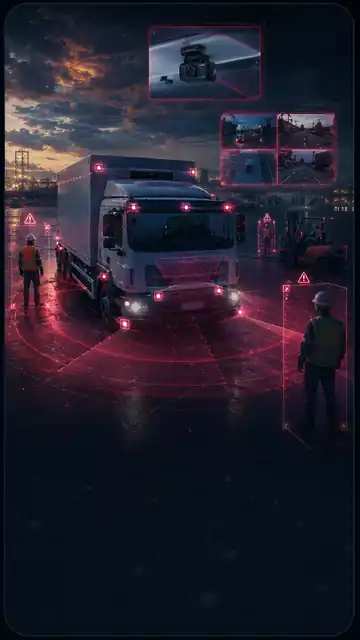
Video telematics & AI safety
Use vehicle video to reduce risk and create useful evidence.
Vehicle camera systems should be designed around the specific risk: blind spots, reversing, people near moving equipment, driver events or incident evidence. Camera position, AI detection and recording are selected around that requirement.
Operational outcomes
What this solution is designed to improve.
The objective is safer manoeuvres, faster incident review and stronger evidence — with video and telematics connected around the event that matters.
Use AI where people or hazards need to be identified in specific zones.
Retain footage around incidents, alarms and selected vehicle events.
Associate footage with location, vehicle and operational context.
Relevant technology
Design the camera system around the risk, not the camera count.
Start with the evidence or safety gap: road incidents, driver events, reversing, blind spots, vulnerable road users or people working around moving equipment. Camera position, AI detection, recording and telematics should follow that risk assessment.
AI camera technology
Relevant technology / delivery
Connected cameras for road, driver and operational safety use cases.
See related details →Multi-camera recording
Relevant technology / delivery
Mobile DVR platforms for vehicles needing several camera positions and event recording.
See related details →Connected operation
Relevant technology / delivery
Bring vehicle, location and event context together around the footage.
See related details →Connected vehicle video proof
Video telematics created measurable fleet value for Empower Energy.
Empower Energy combined dual-camera vehicle telematics and Foretrack Connect to replace phone-based location checks with live fleet intelligence, stronger incident evidence and faster engineer allocation.
Faster allocation using live fleet visibility improved the way engineers were assigned to customer work.
Connected vehicle video and telematics were deployed as one operational fleet workflow.
The published case study reports lower insurance premiums and stronger evidence for claims and incidents.
Fleet location, reporting and vehicle-camera information were brought into the wider connected operation.
Related solutions
Tell us which vehicle risk or evidence gap you need to address.
Start an enquiry →Vehicle video, designed around the risk
From a three-camera dashcam to full multi-camera awareness.
Choose the camera architecture around the evidence and visibility you actually need. A compact dashcam can cover forward, internal and rear views. Larger vehicles and assets can start with four cameras and expand to as many as twelve for comprehensive 360° visibility.
Smart dashcam
See more. Know more. Stay safer.
A compact connected dashcam supporting up to three camera views: forward road, internal cab and rear.
RECForward view
RECInternal view
RECRear view
HD videoClear event evidence
AI detectionSafety events & alerts
Connected4G, GPS & cloud
Up to 3Camera channels
Multi-camera view
Total awareness. Around every angle.
Four cameras is the standard starting point for broader vehicle coverage, with systems scalable to twelve cameras for large assets and complex operating environments.
Forward
Rear
Offside
Nearside
Internal
4–12 camerasScale by asset & risk
360° visibilityBuild coverage around blind spots
AI alertsDetection where it matters
Live + recordedOperational view and evidence
Typical four-camera setup: forward, offside, rear and internal. Add nearside, load area, reversing, equipment-zone or specialist views as the vehicle or asset demands.