Hospitals & NHS estates
Guide patients, visitors and staff from entrances and car parks to clinics, wards, departments and facilities while supporting accessible routes and estate changes.

Help patients, passengers, shoppers, visitors and staff find the right destination across hospitals, airports, museums, shopping centres, campuses, visitor attractions and other complex estates.
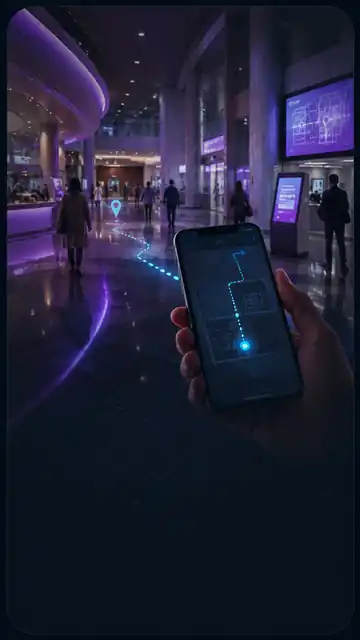
Wayfinding becomes valuable wherever people arrive unfamiliar with the environment, destinations change, buildings span multiple floors or staff repeatedly have to give directions.
Guide patients, visitors and staff from entrances and car parks to clinics, wards, departments and facilities while supporting accessible routes and estate changes.
Help passengers move through terminals, check-in areas, gates, services and connecting spaces with clearer multi-stage journeys.
Make stores, amenities, parking, dining and services easier to discover across large or multi-level destinations.
Guide visitors between galleries, exhibits, facilities and points of interest without forcing every journey into a fixed linear route.
Help students, visitors and contractors navigate buildings, lecture spaces, services and changing campus environments.
Support high visitor volumes with clear routes to entrances, seating zones, facilities, concessions and help points.

A strong wayfinding design keeps the underlying destinations and route logic consistent while presenting the right experience on each touchpoint.
The useful part is the maintained digital model behind the route: destinations, floors, entrances, lifts, stairs, restrictions and the touchpoints people use to ask for directions.
Help users find departments, gates, stores, rooms, services or points of interest by the names they actually recognise.
Build routes through lifts, stairs, corridors, entrances and decision points across complex buildings.
Plan different journey options around relevant access requirements and mapped route constraints.
Use one maintained venue model across web, kiosk and mobile experiences instead of separate disconnected maps.
Keep destinations and route logic current when departments, access points or operational conditions change.
Define who maintains destinations, approves changes and keeps the digital experience accurate after launch.
Our work with Darent Valley Hospital demonstrates how digital wayfinding can support patients, visitors and staff across a complex healthcare estate. Healthcare is now treated as a key sector use case within the main Foresolutions Wayfinding solution.
Technology comes after the operational design. The first job is to understand where people arrive, where they hesitate and how the venue changes over time.
Map entrances, destinations, floors, decision points, accessibility needs and problem journeys.
Create the maintained venue model and destination structure that all wayfinding touchpoints can use.
Define route logic, user journeys and the right mix of web, kiosk, mobile or integrated experiences.
Roll out the experience in the places where visitors and staff actually need guidance.
Keep destinations, routes and venue information current as the estate changes.
We shape the scope around the venue, user journeys, accessibility requirements and the digital touchpoints already in place.
No. The experience can be delivered through a website, QR-led mobile journey or kiosk, with app integration used only where it adds value.
Yes. Route logic can account for floors, lifts, stairs, entrances and mapped decision points across a complex building.
Yes. Healthcare and other public environments can be designed around accessible entrances, lifts and other relevant route constraints.
No. The same wayfinding approach can support airports, shopping centres, museums, campuses, arenas, mixed-use developments and other complex venues.
Bring the venue, a few difficult journeys and the destinations that generate the most questions. We will turn that into a practical wayfinding scope.
Digital wayfinding should be designed around entrances, destinations, accessibility, temporary route changes and the language people actually use to describe the estate. The user experience matters as much as the underlying indoor-location technology.
Rooms, departments, entrances, lifts and landmarks need consistent naming and hierarchy.
Route design should account for lifts, stairs, restricted areas and other practical accessibility requirements.
Hospitals and large estates change over time, so route and destination content must be manageable after launch.
Tell us what is wasting time, creating risk or making work harder. We’ll design the right solution around it.
Asset visibility Track it.•Find it.•Use it. Know where it is. Find what teams need. Keep valuable assets working.
Connected operations Connect it.•See it.•Control it. Connect people and systems. See what matters. Control the response.